Strain-programmable liquid metal fibers for anti-interference electronic textiles
Nature Communications 2026
Abstract
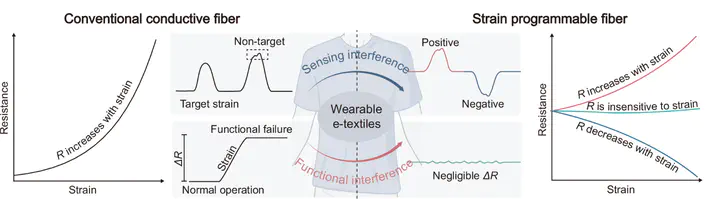
Strain-induced signal interference is a critical challenge for reliable electronic textiles in deformable environments. This work introduces a strain-programmable fiber platform that embeds liquid metal particles within polyurethane elastomer through coaxial wet spinning, turning mechanical deformation from a source of noise into a tunable materials-design parameter. By programming pre-strain and liquid metal composition, the composite fibers can exhibit negative, hybrid, or positive strain-resistance behaviors, arising from strain-induced liquid metal particle reconfiguration and conductive-network evolution. This programmable response enables bidirectional strain sensors with polarity-based digital encoding and strain-invariant circuits for robust energy harvesting, wireless communication, and thermal management. As the first independent research work from the Lin Research Group, this study establishes a materials-level strategy for anti-interference electronic textiles and points toward more reliable multifunctional wearable systems.