An anoxygenic photosynthesis-inspired dual biohybrid for light-enhanced chemical production
Science Advances 2026
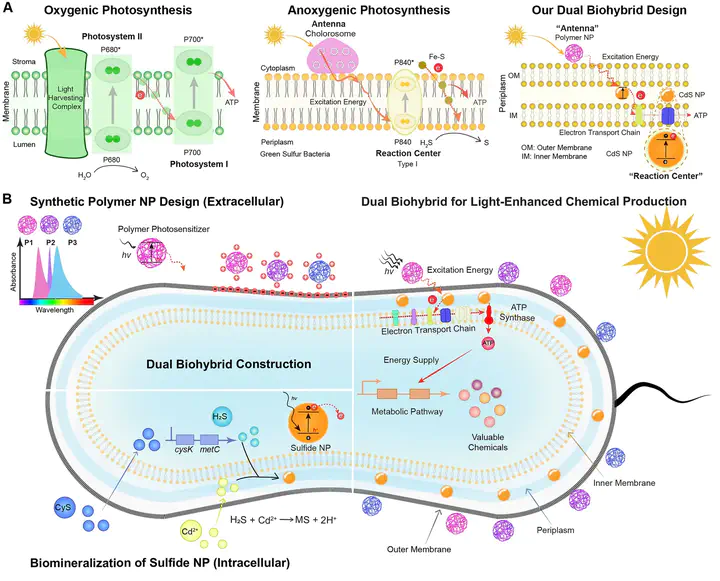 Dual biohybrid design from Fig. 1, panels A and B, of Yang et al., Science Advances (2026), DOI: 10.1126/sciadv.aef4504. CC BY-NC 4.0.
Abstract
Integrating light-harvesting materials with non-photosynthetic microbes offers a promising route to convert sunlight into chemicals. However, many existing biohybrid systems lack a clear architectural basis linking external light capture to intracellular redox processes. Inspired by the modular architecture of anoxygenic photosynthesis, we report a dual biohybrid system for light-enhanced chemical production in Escherichia coli. The system combines extracellular conjugated polymer nanoparticles as light-harvesting antenna with intracellularly biomineralized CdS nanoparticles as reaction-center-like charge-separation modules. This architecture supports light-enhanced malate production, yielding nearly a 30-fold enhancement relative to unmodified cells. Illumination-dependent studies reveal that activity is governed by light absorption, photon flux, and the intracellular redox environment. Fluorescence lifetime imaging microscopy further indicates photophysical coupling between the polymer and CdS components, consistent with energy transfer across the bio-synthetic interface and enhanced intracellular redox activity. Together, these results show how modular organization at the bio-synthetic interface can couple light harvesting with intracellular redox chemistry in living systems.

Ying Yang
Research Fellow
My research interests mainly focus on microbe-polymer semiconductor biohybrids


Yiliang Lin
Assistant Professor in Chemical & Biomolecular Engineering
My research interests include soft matter engineering, wearable electronics, biointerfaces and living materials.