Lin Group @ NUS
Lin Group @ NUS
Home
Research
Team
Publications
News
Opening
Contact
Liquid Metal
Transformable Liquid-Metal Nanomedicine
Nature Communication
2015
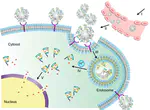
We have developed a new liquid metal-based drug delivery platform for anticancer therapy. The liquid-metal nanomedicines are able to fuse for promoting drug release and eventually degrade under a mild acidic environment.
Yue Lu
,
Quanyin Hu
,
Yiliang Lin
,
Dennis B. Pacardo
,
Chao Wang
,
Wujin Sun
,
Frances S. Ligler
,
Michael D. Dickey
,
Zhen Gu*
PDF
Link
Handwritten, Soft Circuit Boards and Antennas Using Liquid Metal Nanoparticles
Small
2015
We designed a liquid metal based composite that can change from non-conductive states to fully conductive states with mechanical pressure. Therefore, we can simply use a pen to create arbitrary conductive circuits on a soft substrate.
Yiliang Lin
,
Christopher Cooper
,
Meng Wang
,
Jacob J. Adams
,
Jan Genzer
,
Michael D. Dickey
PDF
Link
Liquid-Metal Microdroplets Formed Dynamically with Electrical Control of Size and Rate
Advanced Materials
2015
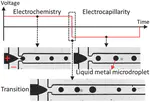
We could tune the liquid metal microparticles size in a flow-focusing device through applying a small voltage to change the liquid metal surface tension.
Shi-Yang Tang
,
Ishan D. Joshipura
,
Yiliang Lin
,
Kourosh Kalantar-Zadeh
,
Arnan Mitchell
,
Khashayar Khoshmanesh*
,
Michael D. Dickey*
PDF
Link
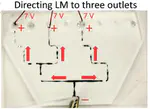
Steering Liquid Metal Flow in Microchannels Using Low Voltages
Lab on A Chip
2015
We demonstrate a novel method for controlling the flow of liquid metal in microchannels simply by applying a modest voltage to the metal relative to a counter electrode placed in the outlet.
Shi-Yang Tang
,
Yiliang Lin
,
Ishan D. Joshipura
,
Khashayar Khoshmanesh*
,
and Michael D. Dickey*
PDF
Link
Ultrastretchable, Cyclable and Recyclable 1- and 2-Dimensional Conductors Based on Physically Cross-Linked Thermoplastic Elastomer Gels
Soft Matter
2013
In this work, we fabricate soft conductive wires composed of liquid metal and elastomer, and such wires could be stretched to more than 10 times of original lengths, without losing their conductivity.
Kenneth P. Mineart
,
Yiliang Lin
,
Sharvil C. Desai
,
Arjun S. Krishnan
,
Richard J. Spontak*
,
Michael D. Dickey*
PDF
Link
«
Cite
×